MyGraph
Makes governing project meaning queryable, so agents act from declared intent instead of guessing it from code. Two tiers, every claim cites evidence, and it is measured against RAG and Graphify on real agent questions.
Why this exists
The dangerous agent failure isn't "I couldn't find the docs." It's that the agent had enough information to continue but not enough grounding to know whether continuing was valid. It can understand code topology perfectly and still miss "we are eliminating this abstraction" or "this module is only a compatibility boundary."
MyAPI, the retrieval layer that came before, found related evidence fast and treated it as equivalent evidence. A stale note outranked the record that superseded it. Graphify, the structural mapper, knew what existed and nothing about what it meant. MyGraph is the clean-room rebuild that puts governing meaning on the path between an agent's question and its action. The longer story is in MyAPI became MyGraph.
What it does
Given sufficient project evidence, answer meaningful questions about a project using both its semantics and its implementation structure, while preserving evidence, authority, temporal state, and uncertainty.
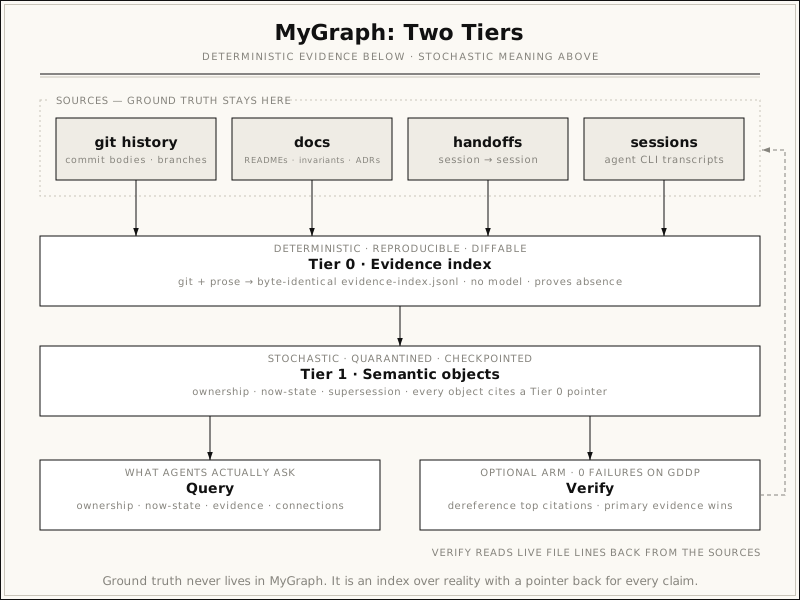
The questions agents actually ask cluster into four kinds, observed from a query log rather than designed: ownership (who may mutate this), now-state (is this live or superseded), evidence (which artifact backs this claim), and connections (trace how a node becomes a job). The boundary is semantics, not volume.
How it works
Tier 0 is deterministic. Git history and prose docs become a byte-identical evidence-index.jsonl per project. No model anywhere, so it is reproducible, diffable, and can prove absence.
Tier 1 is stochastic and quarantined. An LLM extracts typed semantic objects from Tier 0, with checkpoint and resume, per-shard fsync, and byte-identical resumed output. Every object carries a pointer back to the evidence it came from. Uncited assertions are invalid by rule.
Ground truth never lives in MyGraph. It is an index over the repo, not a replacement for it. A fact is true at the commit that says so.
Verify is an optional arm. At query time it dereferences the top citations and lets the live file lines override the object summary, with staleness flags.
Where it stands
First scale run: the two GDDP repos, 25,933 evidence units into 23,044 schema-valid objects, over 11 hours of wall clock with a host sleep in the middle.
The bakeoff: 63 real in-host questions about GDDP, every arm answering the same questions, scored by three fresh agents against a fixed rubric where an honest "this was never implemented" counts as answered.
| Arm | Answered | Failed |
|---|---|---|
| MyGraph | 71.4% | 1 |
| MyGraph + verify | 52.4% | 0 |
| MyAPI (RAG) | 52.4% | 2 |
| Graphify | 15.9% | 4 |
A controlled rerun held within three points. The failure classes stayed distinct: Graphify fabricates identifiers under thin subgraphs, RAG fails temporally, MyGraph's one failure was overtrusting an object's recorded status. Verify cleared that class entirely at the cost of hedging on dead references. On a second project, aa-cli, verify became the higher-scoring arm instead. That trade-off is the current tuning target, not a settled result.
What's next
Authored-object ingestion, so invariants written in AGENTS.md files enter Tier 1 as first-class facts. And the open question of how MyGraph relates to GDAD, which needs exactly this kind of semantic grounding for its evaluator.